
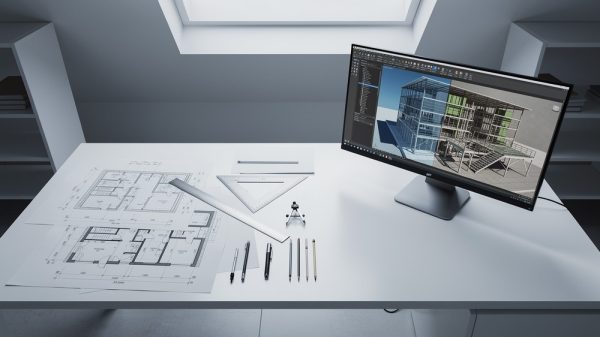
Thorpe Studios converts 2D drawings to 3D models in San Diego for architects, custom home builders, and developers who need to move from a set of construction documents to something they can present, render, animate, or submit to a planning board. I’m a licensed California architect — which means I read your drawings the same way your contractor does. No guesswork about what a dimension means. No interpretation errors because a detail wasn’t immediately obvious. You hand me the files; I build you a 3D model that actually matches what you drew.
This service is for people who have architectural plans and need them in three dimensions. Whether that’s for photorealistic rendering, a fly-through animation, a planning board submission, or a VR walkthrough on a Meta Quest headset — the 3D model is the foundation everything else is built on. Getting that model right from the start means every downstream deliverable is accurate.
What Files Do You Need to Convert 2D Drawings to a 3D Model?
I work from AutoCAD (.dwg), Revit (.rvt), SketchUp (.skp), and 2D plan sets in PDF format. The more complete the drawing set, the faster and more accurate the model. A full set — floor plans, exterior elevations, roof plan, sections, and a schedule of materials or finishes — gives me everything I need to build without assumptions. A partial set is workable, but it will require more back-and-forth to resolve ambiguities.
If you’re starting from hand sketches or purely conceptual drawings, that’s a different conversation — reach out and we can talk through what’s needed to get to a buildable model. Most of the projects I take on are in the construction document or design development phase, where the geometry is defined and the materials are specified.
Why the “Licensed Architect” Part Matters Here
Most 3D modeling services for architecture are run by people who are skilled with software but haven’t formally studied buildings. When they hit an ambiguous detail — a transition between two roof planes, a cantilevered floor element, a complex stair geometry — they make a judgment call based on what looks right to them. Sometimes that’s fine. Often it introduces errors that don’t surface until a client asks why the model doesn’t match what they submitted for permit.
Because I’m a licensed California architect, I don’t interpret construction documents — I read them. When something is ambiguous, I know what the standard detailing conventions say and what the likely design intent is. When something is genuinely inconsistent between drawings, I’ll flag it before building the model, not after you’ve already paid for a rendering of the wrong thing. Visit the About page to read more about the background that makes that difference real rather than a marketing claim.
The 2D to 3D Conversion Process at Thorpe Studios
The process is straightforward. You send your drawing files through the contact form — I’ll provide a secure upload link when we start. I review the set and come back with any clarifying questions before modeling begins. That review step typically takes one business day and is where most of the problems get caught. From there, I build the model in Blender (or in Revit if the project calls for a full BIM output), working from your dimensions rather than from visual approximation.
Turnaround depends on the project’s complexity. A single-family home with a well-documented drawing set typically models in 3 to 5 business days. Larger projects, complex massing, or projects with detailed interior spaces take longer. I give you a specific estimate before work starts — not a range that turns into something else when delivery approaches.
Let’s Start With Your Drawings
If you have a set of plans and need a 3D model built accurately from them, send them over. Get a quote and I’ll review your drawings and give you a specific timeline and price.
What the 3D Model Gets Used For
Once the model exists, every other visualization service follows from it. Photorealistic renderings — exterior, interior, aerial — are rendered directly from the model with Blender. The fly-through animation uses the same model with a choreographed camera path added. The VR walkthrough is the model loaded into a real-time environment for Meta Quest. And if the project warrants it, the model can be converted to a full Building Information Model with automated material lists and quantity takeoffs — a working document your project manager and estimator can use.
This is why it matters that the base 3D model is correct. If the model has a roof pitch that’s off by 3 degrees, that error propagates into every rendering, every animation frame, and every VR experience. Getting the conversion from 2D drawings to 3D model right the first time is the decision that controls the accuracy of everything downstream.
Serving Architects and Builders in San Diego and Orange County
Thorpe Studios works with clients throughout San Diego County, Orange County, and greater Southern California. The 2D to 3D modeling service is delivered remotely — you send the files, I deliver the model. If your project is in San Diego or Orange County and you’d like to meet in person to walk through the drawing set before modeling begins, that’s something I’m available for on select projects. See the service areas page for the full coverage area.
The clients I work with on 3D modeling projects are typically independent architects who don’t have the time or software to build the model themselves, luxury custom home builders who need a detailed model for client presentations and permit submittals, and interior designers who need a 3D room model for renovation visualization. If you’ve been searching for someone to convert 2D drawings to a 3D model in San Diego and you want the person doing it to understand what they’re converting, that’s exactly what Thorpe Studios offers.
Frequently Asked Questions
Can you convert 2D drawings to a 3D model from PDFs alone?
Yes — I work from PDF plan sets regularly. The limitation is that PDF drawings don’t carry the dimensional data that CAD files do, so the modeling process involves more manual measurement and interpretation. The result is accurate, but turnaround is typically longer than with a native CAD file. If you have CAD files available, send those — they’re faster and produce a more precise model.
What’s the difference between a 3D model and a rendering?
A 3D model is the geometric representation of the building — the digital object with dimensions, materials assigned, and spatial relationships defined. A rendering is a photorealistic image produced from that model by a rendering engine that simulates lighting, shadow, and material appearance. Think of the model as the building and the rendering as a photograph of it. The model has to exist before any rendering, fly-through, or VR experience can be created.
Do you handle AutoCAD to 3D rendering as a combined service?
Yes. If you send me AutoCAD files and want finished renderings as the output, I handle the full process — model construction from your DWG files, material application, lighting setup, and rendering in Blender. You get the finished images. The 3D modeling step is part of the workflow, not a separate project. This is true for fly-through animations and VR as well — one intake of your files, one complete set of deliverables.
What happens if my drawings have inconsistencies between sheets?
I flag them before building. This is one of the practical benefits of working with a licensed architect who reads construction documents professionally. If your plan and elevation don’t agree on a wall height, or if a detail on one sheet conflicts with dimensions on another, I’ll bring that to your attention before modeling begins rather than making a guess that turns into a problem later. Most projects have at least one of these — it’s normal. Catching them early is what matters.
Ready to Get Started?
If you have architectural drawings that need to become a working 3D model, send them to Thorpe Studios. A licensed California architect will review your files personally and give you a specific timeline and price — no generic quotes.
Get a Quote or call us at (123) 456-7890.