
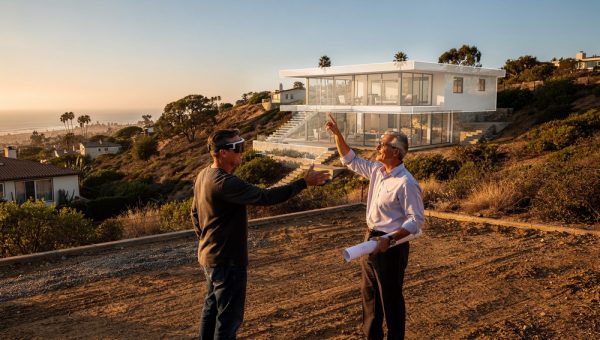
 Thorpe Studios provides AR architectural visualization San Diego architects, builders, and homeowners use to see a project at full scale before it is built. I am a licensed California architect who also writes software, and I run augmented reality presentations directly on a Meta headset — so a client can stand on the actual lot and look at the unbuilt home around them, or place a scaled model on a conference table and walk around it. Very few independent studios in Southern California offer this in person.
What AR Architectural Visualization Means
Augmented reality places a digital building into the real world. Instead of looking at a screen, you wear a headset and see your project anchored to the space in front of you, at true scale, while still seeing the real room or site around you. You can walk up to a wall, look down a hallway, and judge a ceiling height with your own body as the reference.
That spatial sense is the whole point. A floor plan asks a client to imagine; AR augmented reality building visualization San Diego clients can experience the room the way they will actually move through it.
AR and VR Are Not the Same Thing
People use the terms interchangeably, but they solve different problems. Virtual reality drops you into a fully digital world — the room around you disappears. Augmented reality keeps the real world visible and adds the building to it. I offer both, and which one fits depends on the project.
For a remodel or an addition, AR wins because you see the new design against the existing house. For a ground-up build presented in an office, a full VR architectural visualization San Diego session can be the stronger choice. Either way, both run on the same hardware and the same model.
What a Presentation Looks Like on a Meta Headset
A Meta Quest architectural walkthrough is simpler than most people expect. I bring the headset, hand it to you, and you are inside the project in under a minute. The Quest 3 uses color passthrough mixed reality, which means the cameras show you the real room while the model sits inside it — you will not bump into furniture or lose your footing.
According to Meta’s own documentation, the headset blends digital content with your physical surroundings in real time, which is what makes an on-site AR presentation possible without a tethered computer.
Why It Closes Deals and Prevents Change Orders
Change orders are expensive, and most of them come from a client not understanding the design until it is half built. When someone has already stood in the kitchen, the “I thought the island was bigger” conversation happens in the headset, not on the job site. That is cheaper for everyone.
The shift toward this kind of presentation is real. A 2025 peer-reviewed analysis in Frontiers in Built Environment traced steady adoption of VR and AR across architecture and construction, while noting that cost and setup have kept many firms from offering it — which is exactly the gap a solo architect with a software background can fill.
What It Costs and What Affects the Price
Cost depends on how much model already exists. If I have built your project for a photorealistic 3D rendering or a fly-through animation, adding an AR or VR experience is a smaller step because the geometry and materials are done. Starting from raw drawings costs more because the model has to be built first.
The other factor is whether you want a one-time presentation or a reusable file you can show to multiple clients. I scope both. Get a quote from Thorpe Studios and tell me what you are presenting and to whom.
On-Site AR in San Diego and Orange County
The advantage of a local architect is that I show up. On-site AR architectural visualization San Diego clients can only get from someone local: for projects across San Diego and Orange County, I bring the headset to your office, your client’s home, or the lot itself. Standing on the actual site while seeing the proposed building is the version of this that sells work — you can see how the home meets the slope, where the afternoon sun lands, how the view frames up from the great room.
For clients elsewhere across the Southern California areas I serve, I can ship a configured headset or run a guided remote session. It is not quite the same as being on the lot, but it still beats a flat screen.
How to Book an AR Walkthrough
Send me your drawings or an existing model and a short note about the presentation — who the audience is and what you need them to understand. I will tell you honestly whether AR, an immersive architectural presentation VR session, or a plain rendering is the right tool, because the most expensive option is not always the most persuasive one.
From there I build or adapt the model and schedule the session. Because I do every step myself — the same person who builds the VR and AR presentations runs them — there is no handoff and nothing lost in translation.
Frequently Asked Questions
Do I need to own a headset?
No. I bring the Meta headset to the presentation and handle all the setup. You and your clients just put it on. If you want a file to keep and show on your own hardware, I can configure that separately.
Is AR hard for non-technical clients to use?
It is one of the easier things I demonstrate. The headset goes on, the passthrough shows the real room, and the model is already placed. Most people are walking through their project within a minute, no training required.
How is this different from a 3D rendering?
A rendering is a fixed image from one angle. AR lets the client choose where to look and move through the space at full scale. The difference is the same as a photo of a house versus standing inside it — a point I cover in detail in my piece on 3D rendering versus physical models.
Do you travel for on-site presentations?
Yes, throughout San Diego and Orange County for in-person AR sessions, with remote options for the rest of Southern California.
Ready to Get Started?
If you have a project in San Diego or Orange County and want your client to stand inside it before construction, an AR presentation is the fastest way to get them there.